
Roulette is a well-known casino game built around a spinning wheel, numbered pockets, and a small ball. Although the basic concept remains similar across different versions, European and American roulette have important differences. Understanding these variations helps explain how the game works and why the probability of winning differs between the two formats.
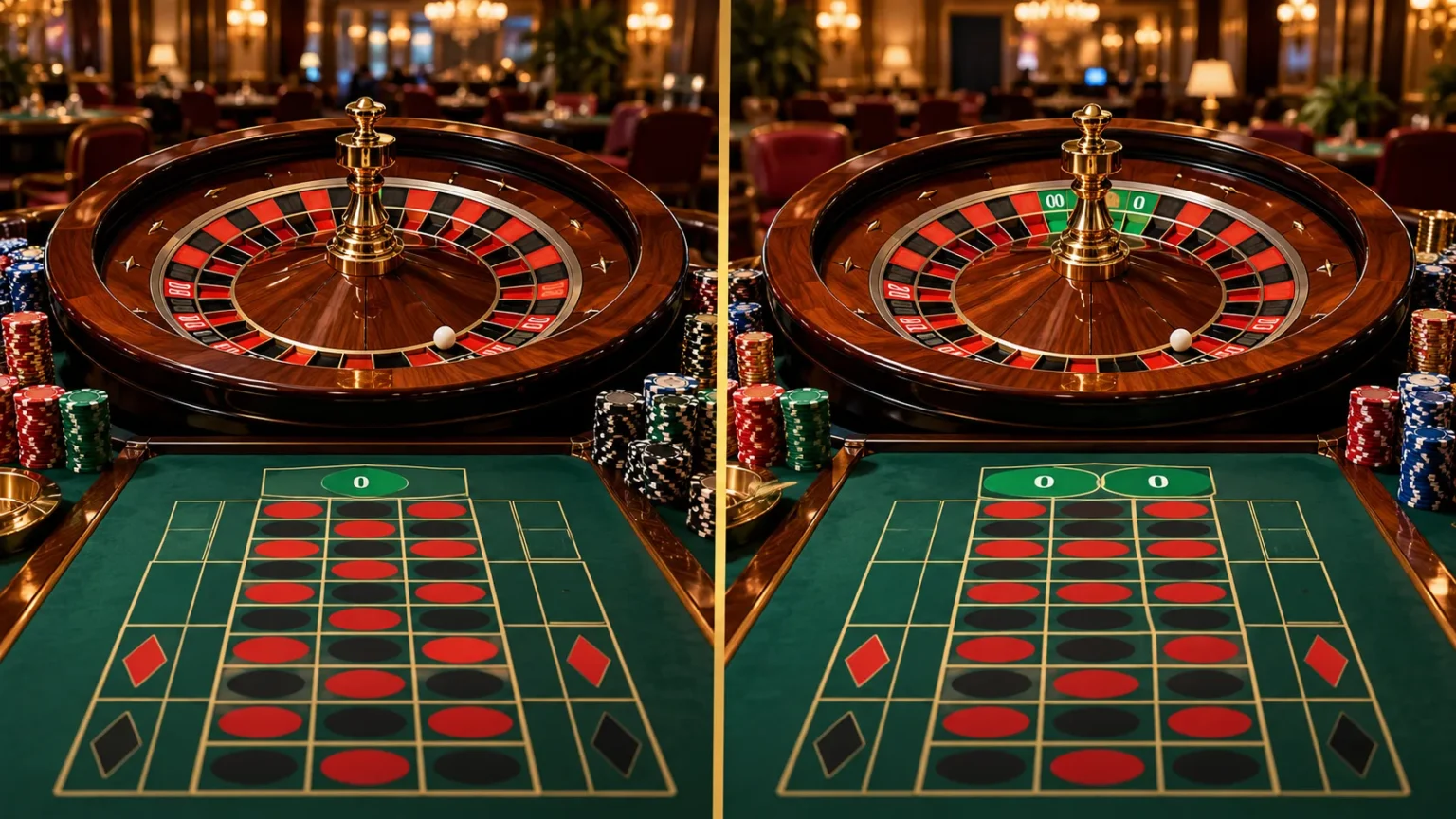
The main difference between European vs. American roulette is the number of pockets on the wheel. European roulette contains 37 pockets, while American roulette includes 38. This additional pocket changes the house edge, probability calculations, and expected returns for different types of bets.
Both versions use similar betting layouts, wheel mechanics, and payout structures. However, their mathematical differences can significantly influence outcomes over many rounds. This guide explains European and American roulette rules, wheel layouts, betting options, probabilities, and other essential distinctions in clear, simple language.
What Is European Roulette?
European roulette is a traditional version of roulette played with a wheel containing 37 numbered pockets. These pockets include numbers from 1 through 36 and a single green zero. The remaining numbers are divided equally between red and black pockets. Players predict where the ball will land by selecting numbers or groups of numbers before the wheel spins.
The European roulette table contains a betting layout that corresponds to the numbered pockets on the wheel. Bets can cover individual numbers, combinations of numbers, or broader categories such as red, black, odd, and even. Each betting category offers different probabilities and payout amounts. The overall system follows standardized mathematical relationships between the number of possible outcomes and the advertised payouts.
One defining feature of European roulette is its relatively low house edge compared with American roulette. Most standard bets carry a theoretical house edge of approximately 2.70%. This percentage represents the casino’s mathematical advantage over a large number of rounds rather than a guaranteed outcome for any individual player. Some European tables also include special rules that affect certain even-money bets.
What Is American Roulette?
American roulette is another widely recognized version of the classic casino wheel game. Its wheel contains 38 pockets numbered from 1 through 36, along with a single zero and a double zero. The two zero pockets are typically colored green, while the remaining numbers are evenly divided between red and black. This additional pocket distinguishes American roulette from its European counterpart.
The American roulette betting layout resembles the European version but includes a separate position for double zero. Players can select individual numbers, combinations, rows, columns, or broader categories. Most conventional betting options use payout ratios equivalent to those found in European roulette. However, the extra pocket reduces the mathematical probability of winning many of these bets.
The standard American roulette house edge is approximately 5.26%, almost twice the European version’s standard advantage. This difference exists because the wheel contains an additional losing outcome for most bets without offering correspondingly higher payouts. Although individual spins remain unpredictable, the mathematical disadvantage becomes more noticeable across large numbers of rounds. Understanding this distinction is essential when comparing roulette variations.
European vs. American Roulette: Main Differences
The most noticeable difference between European and American roulette involves their wheel layouts. European roulette uses 37 pockets, including one zero, while American roulette contains 38 pockets with both zero and double zero. Both wheels feature 18 red numbers and 18 black numbers. The extra green pocket changes the probability of various outcomes without changing most standard payout ratios.
Another major difference involves the theoretical house edge. European roulette generally has a 2.70% house edge, while American roulette has a 5.26% house edge on standard bets. These figures represent long-term mathematical averages rather than predictions about a particular session. The difference comes directly from the number of possible outcomes and the fixed payouts associated with the betting options.
The physical arrangement of numbers around the wheel also differs between these versions. European and American roulette wheels use distinct numerical sequences designed for their respective layouts. Although these arrangements influence the visual appearance of the wheel, they do not make any particular number more likely on a fair wheel. Each pocket has an equal chance of receiving the ball during a properly conducted spin.
European Roulette Wheel Layout Explained
The European roulette wheel contains 37 equally sized pockets positioned around its outer edge. Numbers from 1 to 36 appear in a specific sequence rather than ordinary numerical order. The single zero is green, while the other pockets alternate between red and black in the standard wheel arrangement. This design creates the physical structure used to determine each roulette outcome.
The numerical arrangement on a European wheel differs from the arrangement on the betting table. The wheel distributes numbers around its circumference, while the table usually organizes numbers into three columns and twelve rows. This separation is important because wheel position and table position serve different purposes. The wheel determines the result, while the table displays available betting categories.
Every numbered pocket on a fair European roulette wheel has an equal probability of winning. Because there are 37 possible outcomes, the probability of landing on any particular pocket is approximately 2.70%. The presence of a single zero also affects red-black, odd-even, and high-low bets. Understanding the wheel’s structure provides the foundation for interpreting roulette probabilities.
American Roulette Wheel Layout Explained
The American roulette wheel contains 38 pockets arranged around its circumference. Like European roulette, it includes numbers from 1 through 36, with 18 red pockets and 18 black pockets. However, it features two green pockets labeled zero and double zero. These additional possibilities form the main mathematical distinction between the American and European formats.
American roulette uses a different sequence of numbered pockets around the wheel. The zero and double-zero pockets appear opposite each other in the standard arrangement. The numbered betting layout remains broadly similar to the European table, apart from the additional zero position. This familiar structure allows the same general categories of wagers to exist across both versions.
On a fair American roulette wheel, each individual pocket has a probability of approximately 2.63%. This figure results from dividing one possible outcome by the total of 38 pockets. Because the wheel contains two green pockets, bets on red or black have 18 favorable outcomes and 20 unfavorable outcomes. This mathematical structure produces the higher house edge associated with American roulette.
Understanding the Rules of European Roulette
European roulette begins with a betting period during which participants select their preferred outcomes. Once betting closes, the dealer spins the roulette wheel and releases a small ball in the opposite direction. The ball eventually settles into one of the numbered pockets. The winning number and its corresponding color determine which bets qualify for payment under the table’s rules.
Roulette wagers are generally divided into inside and outside categories. Inside bets cover particular numbers or small groups of numbers, while outside bets cover larger numerical categories. Common outside options include red or black, odd or even, and low or high numbers. The payout for each category depends on how many outcomes the bet covers.
When the ball lands on zero, most outside bets lose under standard European roulette rules. However, certain tables apply special rules such as La Partage or En Prison to eligible even-money bets. These variations can change the amount lost when zero appears. Because table conditions differ, understanding the specific rules is important when comparing European roulette probability calculations.
Understanding the Rules of American Roulette
American roulette follows the same basic spinning-wheel process as European roulette. Participants select outcomes during the betting period, after which the dealer spins the wheel and releases the ball. Once the ball settles, its numbered pocket determines the result. The casino then settles wagers according to the standard payout structure and applicable table conditions.
The primary rule difference comes from the presence of double zero. Both zero and double zero are separate winning outcomes for bets placed specifically on those pockets. However, they generally count as losing results for common outside bets such as red, black, odd, and even. This produces additional unfavorable possibilities compared with the European version.
American roulette also includes a special five-number bet covering zero, double zero, one, two, and three. This wager is sometimes called the basket bet and typically pays 6 to 1. Its theoretical house edge is approximately 7.89%, which is higher than the standard American roulette edge. This exception shows that the house advantage can vary between betting categories.
European vs. American Roulette House Edge
The house edge describes the casino’s expected mathematical advantage over players across a very large number of wagers. It is calculated by comparing the probability of each outcome with the amount paid when that outcome occurs. A higher house edge indicates a greater expected loss relative to the total amount wagered. However, it does not predict the result of individual rounds.
In European roulette, the standard theoretical house edge is approximately 2.70%. American roulette normally carries a 5.26% house edge on conventional bets. For example, if identical amounts were wagered repeatedly under standard conditions, the American version would produce a higher expected loss per unit wagered. Actual short-term results can differ substantially from these averages.
Special European roulette rules can reduce the house edge on eligible even-money bets. Under La Partage, a player loses only half of an eligible even-money wager when zero appears. This reduces the theoretical house edge for those bets to approximately 1.35%. The benefit applies only where the specific rule is offered and does not extend automatically to every betting category.
Comparing Roulette Odds and Probabilities
Roulette probability depends on the number of pockets on the wheel and the number of outcomes covered by a bet. European roulette offers 37 equally likely pocket outcomes, while American roulette offers 38. Because the betting payouts remain largely unchanged, the difference in pocket count directly affects expected returns. A probability comparison makes these differences easier to understand.
Consider a straight-up bet that covers a single number. In European roulette, that number has a 1-in-37 probability of winning, equal to approximately 2.70%. In American roulette, the probability becomes 1 in 38, or approximately 2.63%. Both versions normally pay 35 to 1 for a winning straight-up wager.
For an even-money red bet, European roulette offers 18 winning outcomes out of 37, producing a probability of approximately 48.65%. American roulette has 18 winning outcomes out of 38, resulting in approximately 47.37%. Although the difference appears small on an individual spin, the probability gap explains the higher theoretical house edge in American roulette.
Inside and Outside Bets in Roulette
Inside bets involve selecting one or more specific numbers on the roulette betting layout. Common examples include straight-up bets, split bets, street bets, corner bets, and six-line bets. These categories cover different quantities of numbered pockets and therefore have different winning probabilities. Their payout ratios also vary according to the number of outcomes covered.
Outside bets focus on broader groups of numbers instead of individual pockets. Examples include red or black, odd or even, low or high, dozens, and columns. These bets generally cover more potential outcomes than inside bets, resulting in higher hit probabilities but smaller payout ratios. Nevertheless, their long-term expected returns still reflect the applicable house edge.
Both European and American roulette provide nearly identical inside and outside betting structures. The major mathematical distinction remains the additional double-zero pocket on the American wheel. Choosing a bet with a higher winning probability does not automatically remove the house advantage. Payout size and probability must be considered together when evaluating the mathematics of roulette.
How Roulette Payouts Work
Roulette payouts are determined by the type of bet rather than the specific number that wins. A straight-up wager on one number normally pays 35 to 1, while a split bet covering two numbers pays 17 to 1. Other inside bets offer progressively smaller payouts as they cover additional numbers. These fixed ratios are central to understanding roulette mathematics.
Outside bets generally provide lower payouts because they cover larger groups of outcomes. Red-black and odd-even wagers normally pay 1 to 1, while dozens and columns pay 2 to 1. These payout ratios are standard across both European and American roulette. The difference in expected returns comes primarily from the number of pockets on the wheel.
A winning payout ratio describes profit relative to the original stake, which is usually returned separately. For example, a winning 35-to-1 wager produces 35 units of profit plus the original one-unit stake. However, advertised payouts should not be confused with the probability of winning. Evaluating both figures is necessary to understand the expected value of each roulette bet.
How La Partage and En Prison Rules Work
La Partage is a special rule sometimes available at European roulette tables. It applies to eligible even-money bets when the ball lands on the single zero pocket. Instead of losing the entire wager, the player receives half of the original amount back. This reduces the mathematical disadvantage associated with these particular betting categories.
En Prison is another rule found at certain European roulette tables. When zero appears, an eligible even-money wager may remain on the table for the following spin rather than being settled immediately. The eventual outcome depends on the exact version of the rule used. Under common single-zero implementations, this arrangement produces a theoretical house edge of approximately 1.35%.
Neither rule is universally available at every European roulette table. Some casinos use standard rules without either feature, while others offer one of these variations. American roulette generally does not include these traditional single-zero provisions. Checking which rules apply is essential because their availability affects the mathematical comparison between roulette formats.
Does Roulette Have a Winning Strategy?
Roulette results are governed by probability, and no betting system can guarantee a winning outcome on a fair wheel. Each spin is an independent event, meaning previous results do not change the probability of future numbers appearing. A long sequence of red outcomes does not make black more likely on the next spin. This principle is fundamental to understanding random roulette results.
Several well-known betting systems involve changing wager amounts after wins or losses. Although these systems can alter the distribution of short-term results, they do not eliminate the underlying house edge. Increasing a wager after a loss also increases the amount at risk. Mathematical expectations remain tied to wheel probabilities and payout structures rather than previous outcomes.
The most reliable way to understand roulette is through probability rather than predictions or patterns. Comparing house edges, studying payout ratios, and recognizing the independence of spins provides a clearer picture of how the game operates. Roulette should be understood as a chance-based activity rather than a dependable source of income. No progression system can turn a negative expected-value game into guaranteed profit.
Conclusion
European and American roulette share similar gameplay, betting categories, and payout structures, but their wheel layouts create important mathematical differences. European roulette contains 37 pockets, including one zero, while American roulette has 38 pockets, including zero and double zero. This additional pocket changes winning probabilities and increases the house advantage.
Standard European roulette has a theoretical house edge of approximately 2.70%, compared with 5.26% for standard American roulette. Some European tables also offer La Partage or En Prison rules that reduce the house edge on eligible even-money bets. These differences help explain why the two formats produce different expected returns despite offering similar payout ratios.
Understanding European vs. American roulette requires looking beyond the appearance of the wheel. Pocket counts, probabilities, payout ratios, and special table rules all influence the underlying mathematics. Neither version provides predictable winning outcomes, and every fair spin remains independent. Knowing these principles supports a more accurate understanding of how roulette works.
Frequently Asked Questions
What Is the Main Difference Between European and American Roulette?
European roulette has 37 pockets with one zero, while American roulette has 38 pockets with zero and double zero. The additional pocket increases the American version’s standard theoretical house edge.
Does European Roulette Have Better Odds Than American Roulette?
Yes. Standard European roulette has a house edge of approximately 2.70%, compared with 5.26% for standard American roulette. This means European roulette has a lower mathematical disadvantage on conventional bets.
What Is the Double Zero in American Roulette?
Double zero is an additional green pocket on the American roulette wheel. It creates a 38th possible outcome and increases the house edge because most standard bets lose when the ball lands there.
What Is the La Partage Rule in European Roulette?
La Partage is a rule that returns half of an eligible even-money wager when the ball lands on zero. It reduces the theoretical house edge for those bets to approximately 1.35%.
Can Any Roulette Strategy Guarantee a Win?
No roulette strategy can guarantee winning results on a fair wheel. Each spin is independent, and betting systems cannot eliminate the house edge. Past outcomes do not predict which number will appear next.