
Blackjack is one of the most recognizable card games in the world. Its simple appearance, distinctive card values, and connection to probability have made it a familiar part of popular culture. However, understanding blackjack involves more than recognizing playing cards or knowing that the number 21 is important.
For first-time learners, blackjack terminology and the structure of the game can seem confusing. Words such as dealer, bust, natural blackjack, soft hand, and hard hand have specific meanings. Understanding these concepts helps explain how the game works and why different outcomes occur.
This educational guide explains blackjack rules, card values, common terminology, probabilities, and frequently misunderstood concepts. It also explores the role of the dealer, variations in game rules, and the risks associated with gambling. The information is intended for general learning rather than instructions for participating in real-money gambling.
What Is Blackjack and How Does It Work?
Blackjack is a card game traditionally associated with casinos and other gambling environments. Its central concept involves comparing card totals with the number 21. The game is generally played using one or more standard decks of playing cards. Although its basic structure is straightforward, different versions may have additional rules that affect how outcomes are determined.
The game typically features a dealer and one or more participants. The dealer represents the house and follows specific procedures established by the game rules. Unlike many traditional card games, blackjack does not involve participants competing directly against one another. Instead, the outcome of each participant’s hand is evaluated independently against the dealer’s hand.
Blackjack is also an example of a game that combines chance with mathematical decision-making. The order of cards is uncertain, and no participant can guarantee a particular result. Understanding the relationship between card values, probability, and house rules explains why apparently similar hands can produce different outcomes. These characteristics have made blackjack a frequent subject in mathematics and probability education.
The History and Origins of Blackjack
The history of blackjack stretches back several centuries and includes influences from European card games. One commonly discussed predecessor is vingt-et-un, a French expression meaning twenty-one. Historical accounts connect similar card games with gambling establishments in Europe. However, the exact origins of modern blackjack remain uncertain because several related games developed over time.
As European card games reached North America, their rules and names gradually changed. Different establishments introduced local variations, creating several versions of the same general concept. The name blackjack became associated with the game during its development in the United States. Over time, the American name became widely recognized internationally.
Today, blackjack appears in entertainment media, mathematics discussions, historical studies, and casino settings. Its popularity has encouraged the development of multiple versions with different rules. The game has also influenced academic discussions about uncertainty and decision-making. Studying its history provides useful context without requiring participation in gambling activities or understanding complicated mathematical formulas.
Understanding Blackjack Card Values
Blackjack uses a standard playing-card deck containing 52 cards. The deck includes four suits: hearts, diamonds, clubs, and spades. Each suit contains numbered cards, face cards, and an ace. Unlike games that emphasize matching suits or collecting particular combinations, blackjack primarily focuses on the numerical totals associated with different cards.
Numbered cards generally retain their printed values, while jacks, queens, and kings each have a value of ten. An ace is unusual because it can represent either one or eleven, depending on the hand’s total. This flexibility makes aces an important mathematical feature of blackjack. Card suits normally do not influence the numerical value of a hand.
The distinction between face cards and aces is useful when examining blackjack probabilities. A standard deck contains sixteen cards worth ten points and four aces. This distribution affects the likelihood of particular card combinations appearing. Understanding these values provides the foundation for interpreting blackjack terminology, hand classifications, and the mathematical principles associated with the game.
Why the Number 21 Matters in Blackjack
The number 21 forms the central reference point in blackjack. Card combinations are evaluated according to their total value and whether they exceed this threshold. A total above 21 is described as a bust. The term is important because exceeding the limit changes how a hand is evaluated under standard rules.
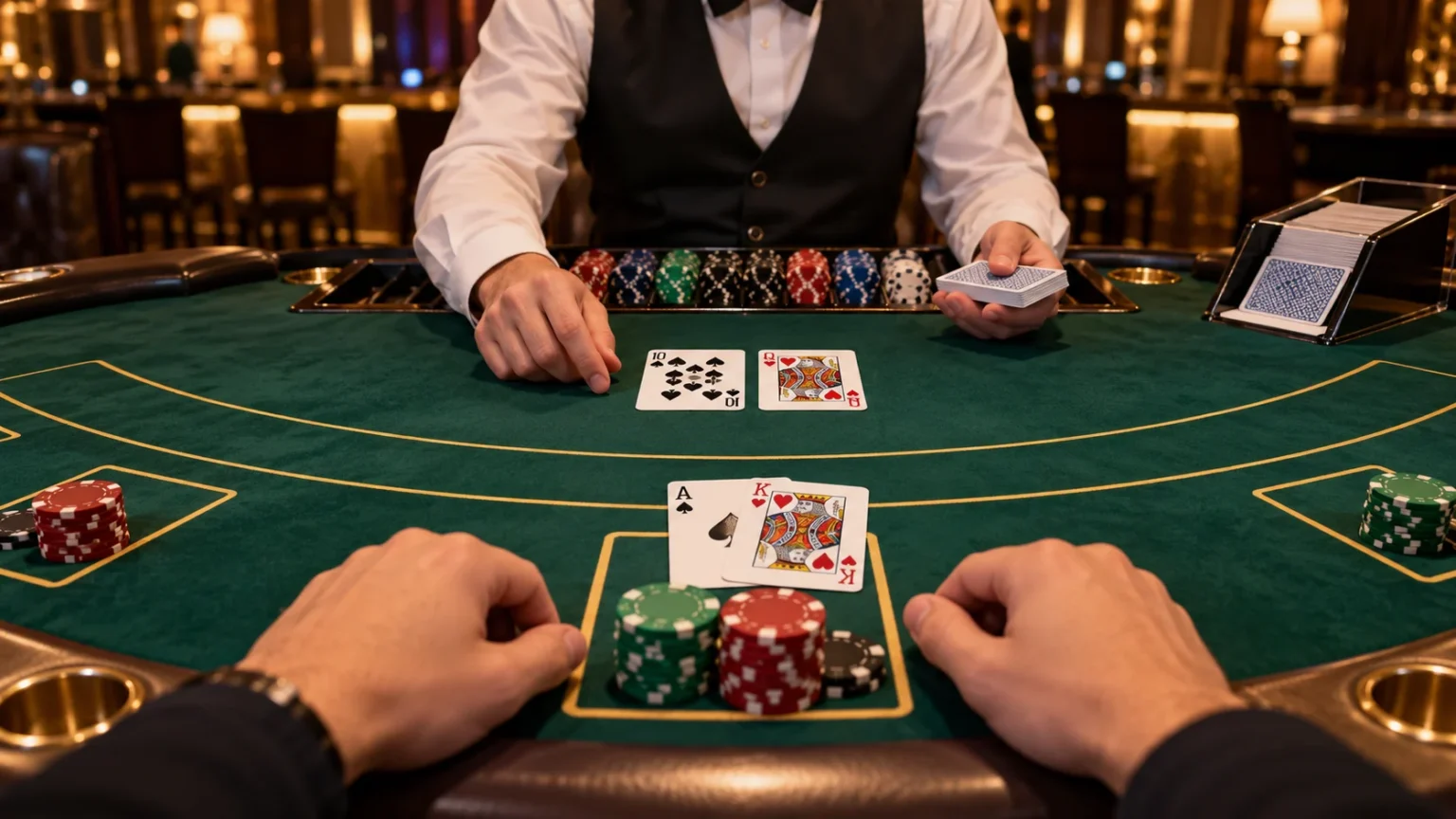
Not every hand totaling 21 has the same classification. A two-card combination consisting of an ace and a ten-value card is commonly called a natural blackjack. Other combinations can also total 21, but they are not necessarily classified as natural blackjack. This distinction affects how outcomes are described in traditional versions of the game.
The number 21 also creates an interesting mathematical boundary. Card values accumulate, but the available distance from the limit becomes smaller as totals increase. This makes blackjack a useful illustration of constrained probability problems. Students can examine these numerical relationships without introducing money, wagers, or competitive gambling into the learning experience.
What Does the Dealer Do in Blackjack?
The dealer is the person responsible for administering the game according to established procedures. In traditional casino blackjack, the dealer represents the gambling establishment rather than another independent participant. The role involves handling cards, maintaining the structure of the game, and identifying outcomes. Dealers are expected to follow rules that limit individual discretion.
A distinctive feature of blackjack is that the dealer’s actions are often determined by specific numerical conditions. For example, different versions establish requirements involving totals such as 16 or 17. These requirements are not identical across every form of blackjack. Consequently, the same card combination may be treated differently depending on the applicable rules.
The dealer’s position also helps explain why blackjack differs from many social card games. Participants do not need to outperform one another for their hands to be evaluated. Instead, each outcome is associated with the relationship between a participant’s total and the dealer’s total. This arrangement is fundamental to understanding the game’s structure.
Common Blackjack Terms and Their Meanings
Blackjack uses several terms that may be unfamiliar to people encountering the game for the first time. A hand refers to the cards associated with one participant or the dealer. A bust means that a card total has exceeded 21. A natural blackjack describes a specific two-card combination involving an ace and a ten-value card.
Two additional terms are soft hand and hard hand. A soft hand contains an ace that can be valued at eleven without causing the total to exceed 21. A hard hand either contains no ace or requires any ace to be valued at one. These classifications describe how the numerical flexibility of aces affects hand totals.
Another common expression is push, which refers to certain tied outcomes. The term house describes the gambling establishment operating the game. House edge refers to the mathematical advantage incorporated into a gambling game’s rules over repeated outcomes. Understanding these terms makes educational explanations easier to follow and reduces confusion when comparing different blackjack versions.
What Are Soft Hands and Hard Hands?
A soft hand illustrates the unusual flexibility of an ace. Because an ace can represent different numerical values, certain combinations have more than one possible total. For example, an ace paired with a six can represent seven or seventeen. When the eleven-point interpretation remains possible, the combination is classified as soft.
A hard hand does not have the same flexibility. A combination containing a ten and a seven produces a fixed total of seventeen. Similarly, a hand containing an ace may become hard when valuing that ace at eleven would exceed 21. These distinctions are mathematical classifications rather than descriptions of a participant’s skill.
Soft and hard hands are often discussed in introductory probability lessons about blackjack. Their differences illustrate how variable numerical values influence possible totals. They also demonstrate why simply counting the number of cards does not fully describe a hand. Understanding these categories can help learners interpret examples without memorizing complex casino procedures.
Understanding Natural Blackjack and Other Totals
Natural blackjack refers specifically to a two-card total of 21 formed by an ace and a ten-value card. The ten-value card may be a numbered ten, jack, queen, or king. This combination has a distinct name because the total is reached using exactly two cards. Additional combinations totaling 21 are classified differently.
For example, a seven, six, and eight collectively have a value of 21. Although the total matches the game’s central number, the combination is not a natural blackjack. The difference is based on the number and types of cards involved. This is an important distinction in explanations of traditional blackjack outcomes.
Different blackjack versions may assign particular significance to natural blackjack. However, the precise treatment depends on the game’s established rules. This variation demonstrates why the word blackjack can refer both to the game itself and to a specific card combination. Recognizing the difference prevents misunderstandings when reading descriptions of blackjack terminology.
What Is a Bust in Blackjack?
A bust occurs when the total value of a hand exceeds 21. The concept is one of blackjack’s defining features because it establishes a strict numerical boundary. A hand totaling 22, for instance, has crossed that boundary. Under standard blackjack rules, a busted hand cannot qualify as a winning hand.
The probability of exceeding 21 depends partly on the current total and the possible values of additional cards. Different starting combinations therefore create different mathematical circumstances. This is one reason blackjack is commonly used to introduce probability and uncertainty. Its numerical limits make the underlying mathematical relationships relatively easy to visualize.
The concept of a bust also applies to the dealer. Dealer outcomes are governed by established conditions rather than personal preferences. Because the dealer and participants are evaluated according to related rules, busts form part of the overall structure of the game. Understanding the term helps explain why some hands produce immediate outcomes.
Understanding Pushes and Tied Hands
A push is a term used in blackjack when certain conditions produce a tied outcome. This generally occurs when the dealer and participant have equivalent qualifying totals. A push is different from a win or loss. The precise classification can depend on the specific blackjack rules being applied.
Ties may appear straightforward, but blackjack includes exceptions involving different hand classifications. For example, natural blackjack has a special status under many traditional rule sets. A hand’s numerical total alone does not always explain every possible outcome. This is why educational descriptions often distinguish between ordinary totals and special two-card combinations.
The idea of a push also illustrates the importance of defined rules in probability-based games. Different games handle equal numerical outcomes in different ways. Some use additional rounds, while others rely on special ranking systems. Blackjack generally uses its established hand classifications to determine how tied totals are treated.
What Are the Different Types of Blackjack?
Blackjack exists in several forms, and their rules are not always identical. Commonly recognized variations include classic blackjack, European blackjack, and Spanish 21. These versions share the general concept of evaluating card totals in relation to 21. However, differences in deck composition and dealer procedures can change the mathematical characteristics of each game.
European blackjack is associated with certain dealing conventions that differ from some American versions. Spanish 21 commonly uses a modified deck that excludes particular numbered cards. Such changes alter the distribution of card values. They demonstrate how relatively small modifications to game design can influence probability and expected outcomes.
Some digital and entertainment versions also borrow blackjack’s familiar terminology and visual structure. However, an electronic simulation may use programmed rules rather than physically shuffled cards. This distinction matters when discussing randomness and game design. Anyone studying blackjack should recognize that rules described for one variation may not apply universally.
How Probability Relates to Blackjack
Probability describes the likelihood that a particular event will occur. In blackjack, probability is influenced by the number of cards, their values, and the rules defining possible outcomes. A standard deck contains cards with different numerical distributions. These differences make some two-card combinations more common than others.
Blackjack is frequently associated with conditional probability, which examines how the likelihood of an event changes when additional information becomes available. Card games provide straightforward examples because the contents of a standard deck are known. However, knowing the possible cards does not mean that future outcomes can be predicted with certainty.
Another important concept is expected value, which describes an average mathematical outcome across repeated events. In real-money blackjack, the rules generally create a long-term advantage for the gambling establishment. Individual results may vary considerably from that average. This distinction between short-term randomness and long-term mathematical expectations is central to understanding gambling risk.
What Is the House Edge in Blackjack?
The house edge is a mathematical concept describing a gambling operator’s expected advantage over repeated play. It is usually expressed as a percentage of the amount wagered. The specific percentage depends on the game’s rules and other assumptions. A house edge does not predict the result of any individual hand.
The concept is sometimes misunderstood as a guarantee that every participant will lose a fixed percentage immediately. In reality, mathematical expectations describe averages across many events. Individual sessions can produce outcomes that differ substantially from the long-term average. This difference is caused by variation and uncertainty rather than a failure of probability theory.
House edge is especially relevant when discussing blackjack because different variations can have different mathematical properties. Changes in card composition or rules affect expected outcomes. Nevertheless, these differences do not eliminate financial risk. Understanding the house edge provides a more realistic perspective on why gambling establishments operate games with uncertain individual results.
Common Misconceptions About Blackjack
One widespread misconception is that previous card outcomes guarantee what will happen next. Although the composition of a physical deck can affect probabilities, uncertainty remains. Observing a particular pattern does not establish that another pattern must follow. This misunderstanding is related to the gambler’s fallacy, a common error in interpreting random events.
Another misconception is that blackjack outcomes are determined entirely by personal skill. While mathematical decisions can influence theoretical outcomes in some versions, randomness remains important. No ordinary player has complete knowledge of future card sequences. Describing blackjack as completely predictable creates an inaccurate impression of how chance-based games function.
A third misconception is that short-term success proves a system is reliable. A small number of favorable outcomes does not establish a predictable long-term pattern. Probability requires examining the full range of possible events rather than isolated examples. Recognizing these misconceptions helps readers interpret blackjack-related claims with greater skepticism.
How Blackjack Differs From Poker and Other Card Games
Blackjack and poker are sometimes grouped together because both are associated with playing cards and gambling establishments. However, their basic structures differ significantly. Blackjack focuses primarily on numerical totals and the relationship between a participant and the dealer. Poker generally emphasizes ranked card combinations and competition between participants.
Another distinction involves the role of the dealer. In blackjack, the dealer represents the house and participates through established procedural rules. In many poker formats, the dealer primarily manages the cards while participants compete against one another. This organizational difference influences how the games are understood and classified.
Blackjack also differs from games such as rummy and bridge. Those games emphasize matching combinations, collecting particular card groups, or winning tricks. Blackjack instead centers on totals within a specified numerical limit. Comparing these structures helps readers understand why similar decks can support games with entirely different objectives.
The Role of Randomness in Blackjack
Randomness is an essential feature of blackjack because card order influences outcomes. In games using physical cards, shuffling changes their arrangement before they are distributed. The resulting sequence is not reliably predictable through ordinary observation. This uncertainty contributes to the variation experienced across different hands.
Digital blackjack simulations may use software to produce randomized card sequences. These systems are designed to imitate aspects of physical card distribution. However, the reliability of a digital system depends on its programming and implementation. A digital presentation that looks realistic does not automatically demonstrate fairness or independent verification.
The broader lesson is that randomness should not be confused with complete disorder. Random events can still be studied mathematically, and their collective patterns can be described using probability. Nevertheless, identifying statistical patterns does not mean every individual outcome can be known in advance. This principle extends far beyond blackjack to many everyday situations.
Gambling Risks and Responsible Awareness
Blackjack is often presented as entertainment, but real-money versions involve financial risk. Gambling outcomes are uncertain, and losses can occur regardless of experience or confidence. The appearance of straightforward rules may make the activity seem easier to predict than it actually is. Understanding this distinction is important when evaluating gambling-related information.
Repeated exposure to gambling can also contribute to unrealistic expectations about money and chance. Promotional materials may emphasize favorable outcomes while giving less attention to losses. This imbalance can make the risks difficult to judge. Educational discussions should therefore distinguish mathematical explanations from claims suggesting that gambling provides dependable income.
Age restrictions and gambling laws vary by location. For younger audiences, exploring blackjack through mathematics, history, and probability is a safer educational approach than real-money participation. Classroom discussions can examine card values, randomness, and numerical classifications without introducing financial stakes. This preserves the learning value of the subject while avoiding unnecessary gambling risks.
Why Blackjack Is Studied in Mathematics
Blackjack provides a recognizable example of how mathematics can describe uncertain events. Its standard deck has a known composition, and the cards have clearly defined numerical values. These features make the game useful for discussing probability distributions and numerical constraints. Students can examine these concepts through hypothetical examples without participating in gambling.
The game’s treatment of aces introduces another interesting mathematical idea. A single card can represent two possible values depending on the surrounding combination. This creates opportunities to study flexible numerical systems and classification rules. Such examples can help learners understand how context changes the interpretation of a mathematical value.
Blackjack also illustrates the difference between probability and certainty. A particular outcome may be more likely than another without being guaranteed. This principle applies to scientific research, weather forecasting, insurance, and everyday decision-making. Studying blackjack as a mathematical model therefore provides insights that are useful well beyond card games.
Conclusion
Blackjack is a well-known card game built around numerical totals, card classifications, and the number 21. Its terminology includes concepts such as natural blackjack, bust, push, soft hand, and hard hand. Understanding these ideas provides a foundation for interpreting the game’s structure and recognizing differences between common variations.
Although blackjack appears simple, probability and randomness play important roles in determining outcomes. Different rules can change mathematical expectations, while individual results remain uncertain. Concepts such as the house edge and gambler’s fallacy help explain why apparently predictable situations may still involve considerable uncertainty.
For first-time learners, the most useful approach is to study blackjack as a subject involving mathematics, history, and game design. Learning card values and terminology does not require real-money gambling. A clear understanding of the game’s concepts also helps readers recognize misleading claims and appreciate the broader lessons about probability and risk.
Frequently Asked Questions
What is the main objective of blackjack?
Blackjack centers on card totals in relation to 21 and the dealer’s total. Under standard rules, qualifying totals are compared to determine outcomes, while totals exceeding 21 are classified as busts.
What is a natural blackjack?
A natural blackjack is a two-card combination consisting of an ace and a card worth ten points. This combination totals 21 and has a special classification in traditional blackjack rules.
What is the difference between a soft hand and a hard hand?
A soft hand contains an ace that can count as eleven without exceeding 21. A hard hand has no such flexibility because its aces must count as one or are absent.
Is blackjack based on luck or skill?
Blackjack involves both randomness and mathematical decision-making. Card distribution creates uncertainty, while game rules influence possible outcomes. Neither experience nor mathematical knowledge can guarantee success in real-money gambling.
Why is blackjack considered a probability-based game?
Blackjack uses cards with known numerical values and distributions. These characteristics allow mathematicians to calculate the likelihood of certain combinations, although individual outcomes remain uncertain because of random card sequences.