
Roulette is a popular casino game that combines a spinning wheel, numbered pockets, and different betting options. One of the most important distinctions in roulette is the difference between inside and outside bets. These two categories determine which outcomes a wager covers, how often it might win, and the payout offered when it succeeds.
Inside roulette bets focus on specific numbers or small groups of numbers, while outside roulette bets cover broader categories such as red, black, odd, or even. Although both categories follow the same basic roulette rules, they have different winning probabilities and payout structures. Understanding these differences makes the game’s mathematics easier to interpret.
Whether you are learning about European roulette, American roulette, or general casino terminology, knowing how inside and outside bets work is useful. This guide explains the main betting categories, their probabilities, payout ratios, and the mathematical principles behind roulette outcomes.
What Are Inside Bets in Roulette?
Inside bets are roulette wagers placed on individual numbers or small combinations of numbers within the main numbered section of the betting layout. These wagers cover relatively few possible outcomes compared with outside bets. As a result, they generally have lower winning probabilities but offer higher payout ratios. The exact probability depends on how many numbers the wager includes.
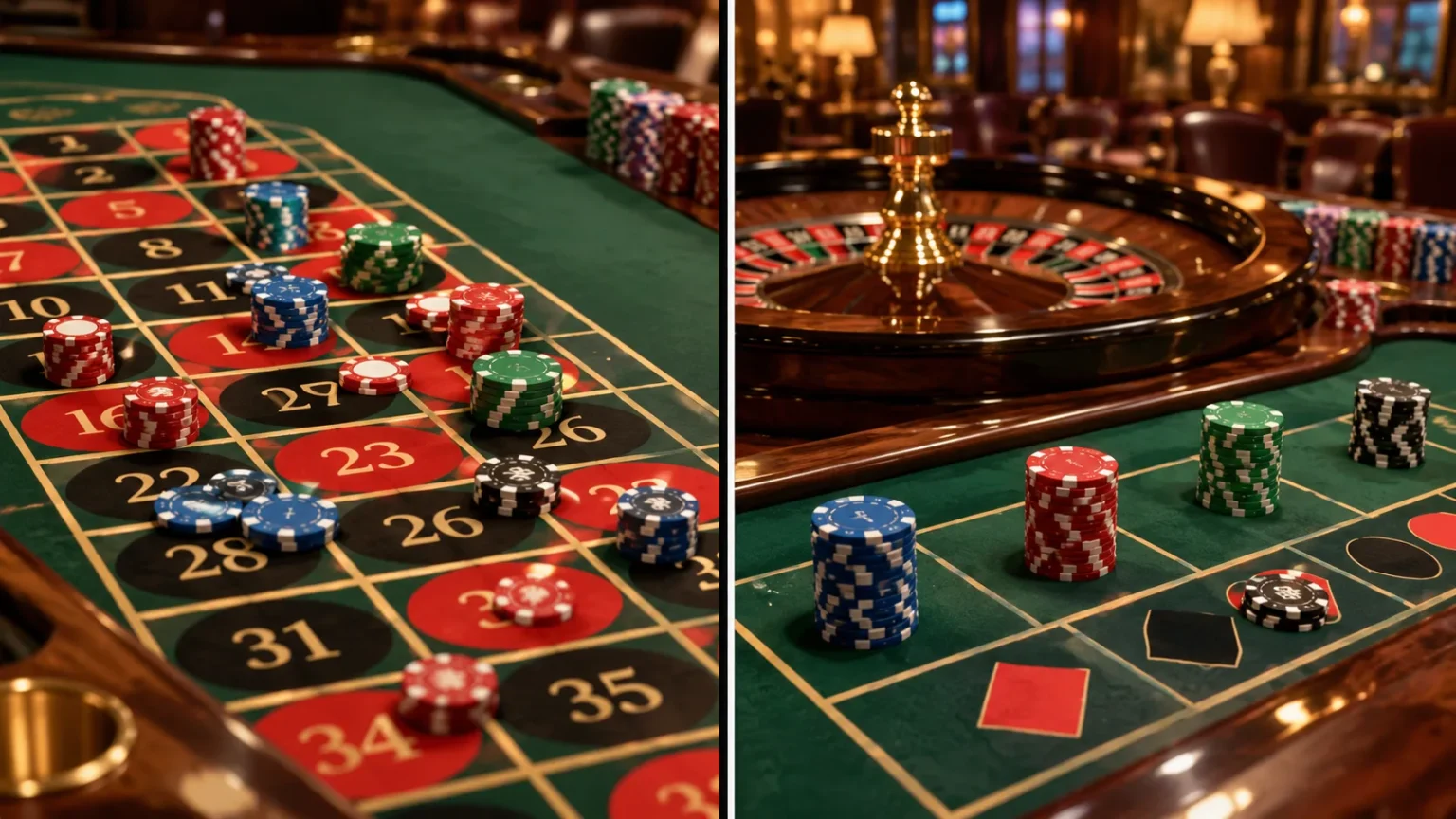
The inside betting area consists of numbers from 1 through 36 arranged in three columns and twelve rows. European roulette also includes a single zero, while American roulette contains zero and double zero. Inside wagers can cover one number, two adjacent numbers, or several connected positions. Each category follows established rules for determining winning outcomes.
For example, a straight-up bet covers one numbered pocket and normally pays 35 to 1 when successful. A split bet covers two numbers and pays 17 to 1. These higher payouts compensate for the smaller number of favorable outcomes. However, they do not eliminate the casino’s mathematical advantage, known as the house edge.
What Are Outside Bets in Roulette?
Outside bets are roulette wagers that cover larger groups of numbers rather than individual pockets. They are placed in sections surrounding the main numbered betting grid. Common outside bets include red or black, odd or even, high or low, dozens, and columns. These categories generally offer a higher probability of winning than most inside bets.
The defining feature of an outside bet is the number of outcomes it covers. A red bet, for example, covers 18 numbered pockets on the wheel. A dozen bet covers 12 numbers, while a column bet also includes 12 numbers. Because these wagers cover multiple possible outcomes, their advertised payout ratios are smaller than those of narrowly focused inside bets.
Outside bets are sometimes described as simpler because their categories are easy to understand. However, a higher probability of winning does not mean an outcome is guaranteed or that the wager has a positive expected return. Zero and double zero, where applicable, also affect these bets. Understanding the complete wheel layout is necessary to interpret their probabilities accurately.
Inside vs. Outside Roulette Bets: Main Differences
The primary difference between inside and outside roulette bets is the number of outcomes each category covers. Inside bets usually target individual numbers or small groups, while outside bets cover broader numerical classifications. This distinction directly influences how frequently a wager can win. It also determines the payout ratio associated with a successful result.
Inside bets typically offer larger payouts because their winning probabilities are lower. For example, a straight-up wager pays 35 to 1, while a red-black outside bet normally pays 1 to 1. These differences are built into the game’s fixed payout structure. Neither category offers guaranteed returns, and both remain subject to the house edge.
Another difference is where the betting options appear on the table. Inside wagers occupy the numbered grid, while outside wagers appear in designated sections around it. Both types are available in European and American roulette, although wheel differences affect their mathematical probabilities. Understanding both categories helps explain how roulette betting systems are organized.
Types of Inside Roulette Bets
Inside roulette bets include several categories distinguished by the number of pockets they cover. The most common options are straight-up, split, street, corner, six-line, and special zero-area wagers. Each category has a specific placement on the betting layout and a corresponding payout. Their probabilities depend on the roulette wheel being used.
A straight-up bet covers a single number, while a split bet covers two adjacent numbers on the betting grid. Street bets cover three numbers in a horizontal row, and corner bets cover four numbers that meet at one point. Six-line bets cover two neighboring rows containing six numbers. These arrangements create progressively wider coverage and lower payout ratios.
Special inside bets may also be available around the zero section of the table. European roulette supports combinations involving its single zero, while American roulette includes options involving zero and double zero. Some American layouts offer a five-number basket bet with a distinct house edge. The availability and exact arrangement of these wagers depend on the table.
Straight-Up Bets: Betting on One Number
A straight-up bet is the most narrowly focused inside wager in roulette. It covers exactly one numbered pocket on the wheel, making its winning probability relatively low. A successful straight-up bet normally pays 35 to 1. This payout ratio applies to standard European and American roulette, even though the wheels contain different numbers of pockets.
In European roulette, a straight-up wager has one favorable outcome among 37 possible results. Its probability of winning is therefore approximately 2.70%. American roulette has 38 pockets, reducing the probability to approximately 2.63%. The small difference in probability contributes to the larger house edge found in the American version.
Straight-up bets illustrate the relationship between limited coverage and larger advertised payouts. Although the potential payout is considerably higher than that of an outside bet, the probability of winning is much smaller. Previous winning numbers do not influence the next outcome on a fair wheel. Each spin remains independent regardless of the numbers selected.
Split, Street, Corner, and Six-Line Bets
Split bets cover two adjacent numbers on the roulette betting grid. They normally pay 17 to 1 and have a European roulette winning probability of approximately 5.41%. Street bets cover three numbers in a single row and pay 11 to 1. The wider coverage increases the chance of winning while reducing the payout compared with a split bet.
Corner bets cover four connected numbers and normally pay 8 to 1. In European roulette, their probability of winning is approximately 10.81%. Six-line bets cover six numbers across two adjacent rows and typically pay 5 to 1. Their European roulette winning probability is approximately 16.22%, reflecting the larger number of favorable outcomes.
These betting categories demonstrate how roulette payouts change as the number of covered pockets increases. A wager covering more numbers has a greater chance of winning a particular spin, but the resulting payout is smaller. The standard house edge remains the same across these ordinary inside bets within a given roulette variation. Higher hit probability alone does not mean better expected returns.
Types of Outside Roulette Bets
Outside roulette bets are divided into several broad categories based on number characteristics and table positions. The most familiar options include red or black, odd or even, and low or high. These wagers each cover 18 numbered pockets on a standard roulette wheel. They are commonly described as even-money bets because successful wagers pay 1 to 1.
Other outside bets include dozens and columns, which each cover 12 numbers. Dozens divide the numbered grid into three groups: 1–12, 13–24, and 25–36. Columns divide the grid into three vertical groups containing 12 numbers each. These wagers normally pay 2 to 1 because they cover fewer outcomes than even-money outside bets.
All standard outside bets are affected by the presence of zero. A red-black wager, for instance, loses when the ball lands on green zero under ordinary rules. American roulette includes double zero as another unfavorable outcome for these categories. Some European variations offer special rules that modify losses on eligible even-money bets when zero appears.
Red and Black Roulette Bets Explained
Red and black bets are among the most recognizable outside wagers in roulette. Both European and American roulette wheels contain 18 red pockets and 18 black pockets. A wager on either color covers all 18 pockets belonging to that category. These bets normally pay 1 to 1 when the selected color wins.
In European roulette, a red or black wager has 18 favorable outcomes out of 37 possible pockets. This produces a winning probability of approximately 48.65%. American roulette has 38 pockets, reducing the probability to approximately 47.37%. Neither probability reaches 50% because the green pockets are not included in either color category.
Some people incorrectly assume that a series of red outcomes makes black more likely to appear next. This belief is known as the gambler’s fallacy. On a fair roulette wheel, previous spins do not alter the probability of future outcomes. The mathematical chance of red or black remains unchanged from one independent spin to the next.
Odd, Even, High, and Low Bets
Odd-even and high-low wagers are additional outside roulette bets covering 18 numbered pockets each. An odd bet includes odd numbers from 1 through 36, while an even bet covers the corresponding even numbers. High-low bets divide the grid into numbers 1–18 and 19–36. Each category uses a fixed group of outcomes.
These wagers normally pay 1 to 1 because they cover the same number of pockets as red-black bets. Their winning probabilities are approximately 48.65% in European roulette and 47.37% in American roulette. The presence of green pockets prevents either category from having an equal number of winning and losing outcomes. This difference creates the standard house edge.
Although odd-even and high-low bets cover different combinations of numbers, their underlying mathematical expectations are equivalent under standard rules. Selecting one category instead of another does not change the probability of winning. The outcome depends entirely on where the ball lands during that spin. Patterns in previous results do not provide a reliable prediction.
Dozen and Column Bets Explained
Dozen bets divide the roulette number grid into three groups containing twelve numbers each. The first dozen covers numbers 1 through 12, the second covers 13 through 24, and the third covers 25 through 36. These outside bets normally pay 2 to 1. The zero pockets do not belong to any dozen.
Column bets also cover twelve numbers, but they follow the vertical organization of the numbered betting grid. Each column contains one number from every row of the standard layout. A successful column wager also pays 2 to 1. The difference between dozens and columns involves number selection rather than the number of possible winning outcomes.
On a European roulette wheel, a dozen or column bet has a probability of approximately 32.43%. In American roulette, that probability decreases to approximately 31.58%. Both categories have the same theoretical house edge as most other standard bets within their respective roulette variations. Their different number arrangements do not change the underlying mathematical expectation.
Inside vs. Outside Roulette Bets: Payout Comparison
Roulette payout ratios are designed around the number of outcomes included in a wager. Narrower inside bets offer larger returns when successful, while broader outside bets offer smaller returns. This relationship explains why a straight-up wager pays much more than a red-black wager. Understanding payout ratios is essential when comparing the two categories.
For standard roulette, the most common payout ratios are:
| Bet Type | Numbers Covered | Payout |
|---|---|---|
| Straight-up | 1 | 35:1 |
| Split | 2 | 17:1 |
| Street | 3 | 11:1 |
| Corner | 4 | 8:1 |
| Six-line | 6 | 5:1 |
| Dozen | 12 | 2:1 |
| Column | 12 | 2:1 |
| Red or black | 18 | 1:1 |
| Odd or even | 18 | 1:1 |
| High or low | 18 | 1:1 |
A payout ratio describes the profit paid on a successful wager relative to its original amount. For example, a 5-to-1 payout represents five units of profit for each unit wagered, with the original stake normally returned separately. Higher payouts should never be interpreted as higher winning probabilities. Roulette mathematics involves a trade-off between the number of covered outcomes and the payout offered.
Inside vs. Outside Roulette Bets: Winning Probabilities
Winning probability is determined by dividing the number of favorable outcomes by the total number of pockets on the wheel. European roulette has 37 pockets, while American roulette has 38. Therefore, the same betting category generally has a slightly higher probability of winning in the European version. This applies to both inside and outside wagers.
The following table compares standard roulette probabilities:
| Bet Type | European Roulette | American Roulette |
|---|---|---|
| Straight-up | 2.70% | 2.63% |
| Split | 5.41% | 5.26% |
| Street | 8.11% | 7.89% |
| Corner | 10.81% | 10.53% |
| Six-line | 16.22% | 15.79% |
| Dozen | 32.43% | 31.58% |
| Red or black | 48.65% | 47.37% |
These percentages reveal the difference between narrowly focused and broadly focused wagers. Outside bets such as red or black have substantially higher winning probabilities than individual-number bets. However, their payout ratios are correspondingly smaller. The probability of winning one round should not be confused with the expected profitability of repeated wagers.
How the House Edge Affects Both Bet Types
The house edge represents the casino’s expected mathematical advantage across a large number of wagers. It reflects the relationship between the probability of winning and the payout offered. In standard European roulette, most conventional wagers have a theoretical house edge of approximately 2.70%. Standard American roulette generally carries a house edge of approximately 5.26%.
An important fact is that standard inside and outside bets usually have the same house edge within the same roulette variation. A straight-up wager and a red-black wager in standard European roulette both have a 2.70% house edge. Their outcomes feel different because the winning probabilities and payout sizes differ. However, their average expected loss per unit wagered is mathematically equivalent.
Certain exceptions can change these calculations. The American five-number basket bet has a theoretical house edge of approximately 7.89%, higher than ordinary American bets. Some European tables offer La Partage or En Prison rules that reduce the house edge on eligible even-money wagers. These exceptions demonstrate why specific table rules matter when interpreting roulette odds.
Common Misconceptions About Inside and Outside Bets
One common misconception is that outside bets are automatically profitable because they win more frequently. Although outside wagers cover more numbers, their payouts are smaller. A higher winning probability does not eliminate the possibility of repeated losses or the mathematical house advantage. Expected returns depend on both probability and payout, not simply the frequency of winning.
Another misconception is that inside bets can produce reliable profits through number prediction. Roulette outcomes cannot be consistently predicted from previous results on a fair wheel. A number that has not appeared for many spins is not mathematically due to appear. Each numbered pocket retains the same probability on every independent spin, regardless of past patterns.
Some betting systems also suggest that increasing wager amounts after losses can overcome unfavorable odds. However, changing stake sizes does not alter the probability of any roulette result or remove the house edge. Such systems can increase financial exposure without changing the underlying mathematics. Understanding these limitations helps distinguish probability-based explanations from misleading claims about guaranteed results.
Conclusion
Inside and outside roulette bets represent two different ways of grouping potential outcomes on a roulette wheel. Inside bets cover individual numbers or smaller combinations, while outside bets cover larger categories such as colors, dozens, and columns. These differences create distinct payout ratios and winning probabilities, even though the same wheel determines every result.
Inside bets generally offer larger payouts with lower probabilities of winning, while outside bets provide smaller payouts with more favorable single-spin probabilities. However, standard wagers in the same roulette variation usually share the same theoretical house edge. The European wheel’s single zero produces a lower standard house edge than the American wheel’s zero and double zero.
Understanding the difference between inside and outside roulette bets is mainly about recognizing how probabilities and payouts relate. Neither category guarantees positive results, and no betting pattern can predict future spins on a fair wheel. Learning these mathematical principles provides a clearer understanding of roulette rules, terminology, and the role of chance.
Frequently Asked Questions
What Is the Difference Between Inside and Outside Bets in Roulette?
Inside bets cover individual numbers or small groups of numbers, while outside bets cover larger categories such as red, black, odd, even, dozens, and columns. Their main differences involve winning probabilities and payout ratios.
Do Inside Roulette Bets Pay More Than Outside Bets?
Inside bets generally offer higher payout ratios because they cover fewer possible outcomes. For example, a straight-up bet pays 35 to 1, while a red-black outside bet normally pays 1 to 1.
Are Outside Bets More Likely to Win?
Outside bets generally have higher winning probabilities because they cover more numbered pockets. However, they offer smaller payouts and do not eliminate the house edge or guarantee profitable results.
Do Inside and Outside Bets Have the Same House Edge?
Most standard inside and outside bets share the same house edge within a given roulette variation. Exceptions include certain special bets and European tables offering rules such as La Partage.
Can Roulette Betting Systems Predict Winning Numbers?
No. Roulette spins are independent events on a fair wheel, so previous results cannot reliably predict future numbers. Betting systems may change wager amounts, but they do not eliminate the casino’s mathematical advantage.