
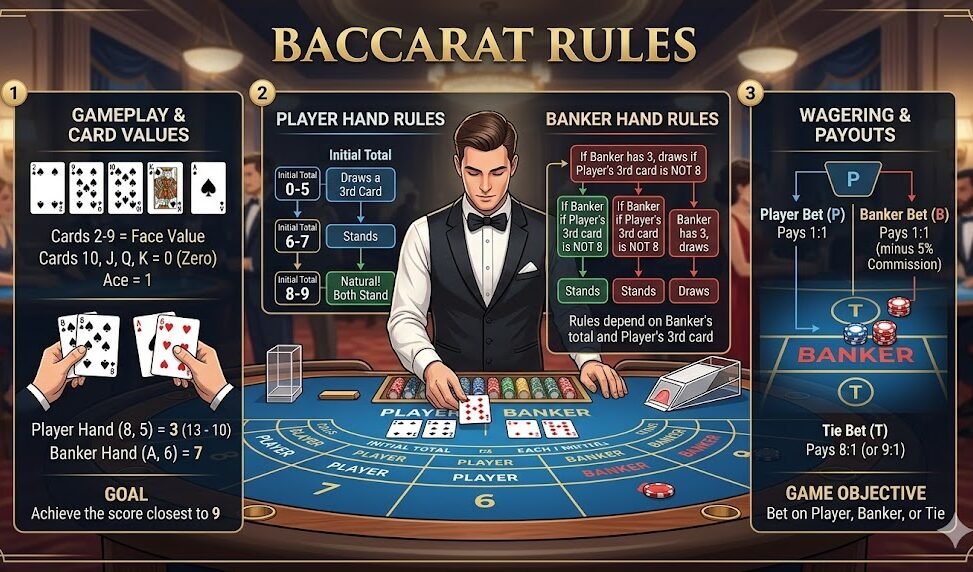
Baccarat rules is a popular card game frequently found in casinos around the world, celebrated for its simplicity and elegance. The game typically involves two hands being played: the ‘Player’ and the ‘Banker.’ The objective is to predict which hand will close with a total closest to nine points. Unlike many other card games, baccarat is primarily a game of chance, rather than skill, which makes it attractive to both novice and seasoned players.
In baccarat, the value of the cards is straightforward. Aces count as one point, cards from two to nine are worth their face values, and tens, jacks, queens, and kings have no value at all. When the total of a hand exceeds nine, only the last digit is considered; thus, a hand consisting of a 7 and an 8 (totaling 15) is valued at 5 points. This unique scoring system distinguishes baccarat from other casino games and contributes to its allure.
There are several variations of baccarat, the most notable being Punto Banco, Chemin de Fer, and Baccarat Banque. Punto Banco is the most commonly played version in casinos today, where the outcome relies heavily on the draw of the cards. In Chemin de Fer and Baccarat Banque, players can take on the role of the banker, introducing an element of strategy that is less prevalent in the simpler Punto Banco format.
Ultimately, understanding the rules and mechanics of baccarat is essential for playerslooking to engage with the game effectively. Familiarizing oneself with the formats and card values can not only enhance enjoyment but also increase the likelihood of making informed betting decisions. As players immerse themselves in this intriguing card game, recognizing its unique features will undoubtedly enrich the overall experience.
Choosing the Right Baccarat Variation
Baccarat is a captivating card game that has garnered popularity in casinos worldwide, showing substantial appeal in both land-based and online gaming environments. When it comes to playing baccarat, one of the most crucial decisions a player needs to make is choosing the right variation that aligns with their preferences and skill level. The three most prevalent variations of baccarat are Punto Banco, Chemin de Fer, and Baccarat Banque.
Punto Banco is the most commonly played form of baccarat, especially in casinos across North America. This version is characterized by its simplicity, as players do not have the option to make strategic decisions once the cards are dealt. The objective in Punto Banco is straightforward: players can bet on the ‘Player’, the ‘Banker’, or a tie. Given its simple structure, Punto Banco is ideal for novices who appreciate a more straightforward approach without the need for intricate strategies.
In contrast, Chemin de Fer offers a more interactive experience where players can assume the role of the banker and have the opportunity to make decisions regarding the gameplay. This variant is popular in Europe and is distinguished by its unique betting structure and player involvement, which appeals to those who enjoy a more strategic approach. Notably, Chemin de Fer is often played with a smaller group, adding an element of exclusivity to the experience.
Finally, Baccarat Banque also allows players to take on the role of the banker, similar to Chemin de Fer, but typically involves larger stakes and varying game dynamics. This variation is less prevalent but is favored by seasoned players looking for a challenge. Understanding the differences between these baccarat variations is essential for making an informed choice that complements your playing style and enhances your gaming experience.
Understanding the Betting Options
In baccarat, players have three primary betting options available: the Player bet, the Banker bet, and the Tie bet. Each of these options has distinct characteristics and outcomes that every player should understand before placing their wagers.
The Player bet is straightforward. When a player opts for this bet, they are wagering on the possibility that the Player hand will win. Statistically, this bet offers a winning probability of approximately 44.5%, which, while enticing, also carries a house edge of around 1.24%. This makes it a reasonable option for those hoping to see their wagers rewarded.
On the other hand, the Banker bet is considered the most advantageous among the three options due to its lower house edge of approximately 1.06%. When placing a Banker bet, one is betting that the Banker hand will secure a win. Statistically, this bet has a winning probability of about 45.8%. Although a 5% commission is deducted from winning Banker bets, the advantageous odds tend to make it more favorable for long-term play.
The final option is the Tie bet, where players wager that both the Player and the Banker hands will finish with the same total. While this bet offers a generous payout of 8:1, the reality is that it has the lowest probability of winning, at around 9.5%, along with a significantly higher house edge of approximately 14.4%. Given these statistics, this bet is generally considered less favorable for players aiming to maximize their long-term success.
In summary, understanding the odds and characteristics associated with each betting option in baccarat can have a profound impact on one’s overall experience and potential success in the game. Players are advised to weigh their options carefully and choose bets that align with their strategies and risk tolerance.
Bankroll Management Strategies
Effective bankroll management is an essential aspect of playing baccarat, as it helps players make informed decisions and prolong their gaming experience. By establishing limits on betting amounts, individuals can enjoy the game responsibly while minimizing potential financial losses. The first strategy is to set a budget before playing. This budget should represent an amount one is comfortable losing, which fosters a more enjoyable atmosphere without the stress of financial concerns.
Once a financial limit is established, the next step is to divide the bankroll into smaller amounts for each gaming session. This approach prevents players from overspending in any single session and encourages a more disciplined method of play. For instance, if a player has a bankroll of $1,000, they might decide to allocate $200 per session. This not only stretches the bankroll over multiple sessions but also allows for better control over betting decisions.
Furthermore, utilizing a targeted betting strategy can assist players in enhancing their bankroll management. Rather than wagering large sums on specific hands, consider using a percentage-based system where only a small fraction of the total bankroll is wagered on each hand. A common recommendation is to limit bets to 1-5% of the total bankroll per hand, ensuring that players maintain control over their funds.
Another crucial aspect of effective bankroll management involves the discipline to resist the urge to chase losses. When encountering a losing streak, players may feel compelled to increase their bets in an attempt to recover losses. This tactic can often lead to even larger losses and disrupt the entire bankroll strategy. Instead, it is advisable to take a step back, reassess the situation, and adhere to predetermined limits, ensuring a sustained and enjoyable experience in baccarat.
The Impact of Card Counting and Tracking
Card counting is a strategy often associated with games like blackjack, where players can track the ratio of high to low cards remaining in the deck. However, the application of card counting in baccarat is not as practical due to the nature of the game and the mechanics of shuffling. In baccarat, the casino typically shuffles the cards after a set number of rounds, making it difficult for players to maintain an accurate count. Additionally, players have no influence over which cards are dealt, which limits the effectiveness of tracking individual hands.
While some players might attempt card counting in baccarat with the hope of gaining a betting advantage, the frequent reshuffling reduces the feasibility of such strategies. The primary goal in baccarat is to bet on either the player’s hand, the banker’s hand, or a tie, based on instinct or predefined strategies rather than detailed card tracking.
Another aspect to consider is the practice of tracking past results. Many players believe that by analyzing previous outcomes, they can identify patterns that predict future results. While this method may provide some insight into potential trends in the game, it ultimately falls into the realm of gambling superstition. The outcome of each baccarat hand is independent of prior hands, and the odds remain constant regardless of prior results. Therefore, reliance on historical data is generally not a sound strategy for players wishing to achieve success in baccarat.
In conclusion, while card counting and tracking past results may offer some level of engagement in the game, they are not effective strategies for gaining an advantage in baccarat. Players should focus on understanding the game mechanics and employing solid betting strategies to improve their overall experience.
Using Betting Systems Effectively
Baccarat, a card game synonymous with elegance and strategy, has attracted players from various backgrounds throughout the ages. One of the intriguing aspects of baccarat is the diversity of betting systems available to enhance the gaming experience. Among these notable systems are the Martingale, Paroli, and Fibonacci systems, each possessing distinct characteristics that can influence a player’s approach and success rate.
The Martingale system, perhaps the most famous among betting strategies, involves doubling your bet after every loss. The primary advantage of this system lies in its perceived ability to recover losses, as hitting a win will theoretically return all previous losses along with a profit equal to the original bet. However, its downside includes the risk of quickly reaching the table’s betting limits, resulting in significant financial loss before ultimately securing a win.
In contrast, the Paroli system promotes a positive progression strategy, encouraging players to increase their bets after wins. This method allows players to capitalize on winning streaks while minimizing losses during unfavorable rounds. While the Paroli system can yield winnings during short-term upswings, it requires discipline and awareness to avoid overextending bets during gambling sessions.
The Fibonacci system, derived from the famous mathematical sequence, involves betting based on the sum of the previous two bets. This system is viewed as a moderate approach, balancing risk and reward. While it may not promise rapid gains, it is designed to manage losses better than the Martingale system when applied over more extended gameplay periods. Each of these systems presents varying degrees of effectiveness based on individual playing styles and the unpredictable nature of baccarat.
Reading the Table and Keeping an Eye on Patterns
In baccarat, reading the table effectively and keeping a close watch on patterns can be an advantageous strategy for players. The game’s simplicity is often deceptive; although it is largely based on chance, the ability to observe prior outcomes can help inform future betting decisions. Players often have the misconception that baccarat is random, but many enthusiasts believe that trends do exist, and recognizing these trends can provide a significant edge.
One common practice among seasoned players is to maintain a record of the results of previous hands. By doing so, they can create a visual representation of recurring patterns, such as streaks of wins for either the Player or Banker. These records, often displayed on scorecards, allow players to analyze whether certain outcomes tend to follow one another, potentially guiding future bets. For instance, if the Banker shows a winning streak, some players may opt to place their bets on the Banker in anticipation of the continuity of that trend.
However, while pattern observation can be a helpful part of a player’s strategy, it is crucial to approach this method with caution. Baccarat is inherently unpredictable, and no past outcome guarantees future results. Therefore, while patterns may emerge, players should not over-rely on them. Instead, understanding that trends are not infallible can help maintain a balanced approach, allowing players to enjoy the game without falling into the trap of expectation.
Ultimately, while observing patterns and keeping meticulous records can enhance the enjoyment of baccarat and support strategic bets, it should be just one of several methods employed by players. This awareness is critical in balancing risk with potential rewards, thereby enriching the overall gaming experience.
Avoiding Common Mistakes
Baccarat is a popular card game often found in casinos worldwide. While it is a game of chance, players can significantly enhance their experience and potential for winning by avoiding several common mistakes. One frequent pitfall is the tendency to bet on a tie. Although the payout for a tie bet is enticing, the odds against a tie occurring make it a less favorable option. Players should be cautious and consider the established statistical probabilities, focusing instead on the banker and player bets, which have a better chance of winning in the long run.
Another common error among baccarat players is poor emotional management. The excitement of the game can lead to impulsive decisions, further compounded by the belief that previous outcomes influence future results. Players often fall into the trap of chasing losses, which can lead to larger bets and more significant losses. It is vital for players to maintain a clear head and stick to predetermined limits. Establishing a budget beforehand and adhering to it can help in minimizing emotional responses during gameplay.
Additionally, many players neglect to utilize a strategic approach to betting patterns and game flow. Although baccarat is rooted in luck, employing a strategy, such as flat betting or the Martingale system, can improve overall gameplay. These methods allow players to manage their bankroll effectively while mitigating risk. Taking the time to learn the rules thoroughly and practicing the game through free online platforms can also provide invaluable experience. By being aware of these common mistakes and actively working to avoid them, players can develop a more robust strategy and enjoy the game of baccarat with a higher chance of success.
Conclusion: Putting It All Together
Winning at baccarat requires not only an understanding of the game’s rules but also the implementation of thoughtful strategies. Throughout this blog post, we have discussed several key tips that can enhance your gameplay and increase your chances of success. First and foremost, it is crucial to comprehend the different types of bets available within the game, particularly the banker, player, and tie bets. Betting on the banker is statistically the best option due to its lower house edge, making it a preferred choice for many seasoned players.
Another significant point highlighted is the importance of managing your bankroll effectively. Establishing a budget prior to playing ensures that you do not exceed your financial limits, thereby promoting responsible gaming practices. By sticking to your predetermined limits, you can enjoy the game without the stress of financial strain.
Moreover, maintaining a calm and collected mindset during play is vital. Emotional decisions can lead to poor betting choices, emphasizing the necessity of staying composed even during both winning and losing streaks. Additionally, recognizing patterns in the game can be beneficial, although it is important to remember that baccarat is ultimately a game of chance.
Lastly, while implementing these strategies is essential, it is equally important to remember that baccarat is a form of entertainment. Enjoyment should remain at the forefront of your experience, and employing a strategic approach can enhance this enjoyment rather than detract from it. We encourage you to apply these tips in a practical setting, examining how they influence your gameplay and overall enjoyment.
By blending strategy with entertainment, you are likely to foster a positive and rewarding baccarat experience.