
For those new to the game, grasping the fundamentals of poker tournament basics is essential for a successful experience. Unlike cash games, where players can enter and leave at any time, poker tournaments have a structured format with set rules and specific objectives dictated by the event.
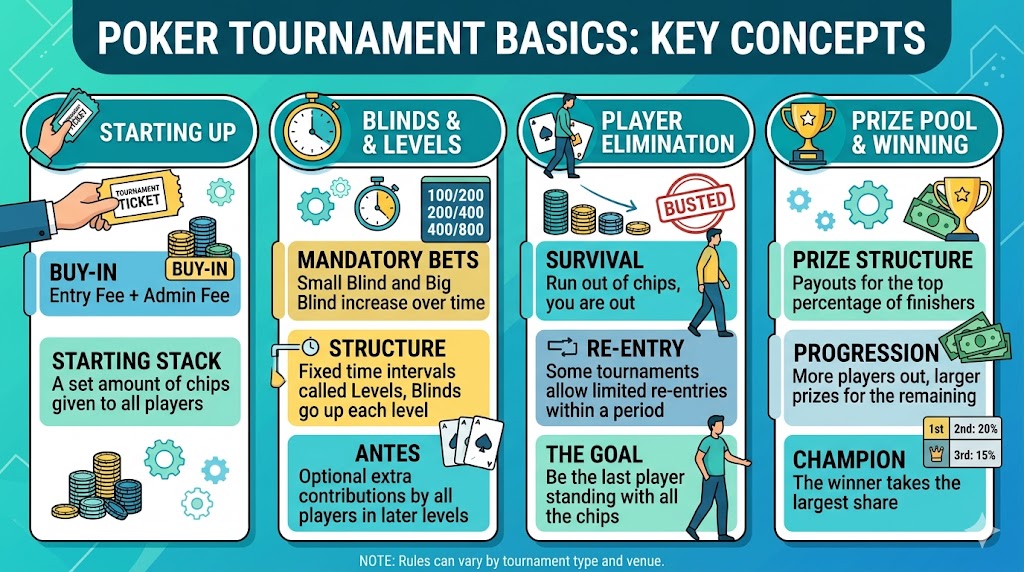
Key terms play a pivotal role in understanding how tournaments operate. A ‘buy-in’ refers to the entry fee that players must pay to participate in the tournament. This amount varies based on the tournament’s scale and prestige, determining the overall prize pool. Players receive a predetermined number of tournament chips for their buy-in, which signifies their stake in the event.
‘Blinds’ are important aspects of tournament play, representing forced bets that increase progressively to encourage action. Blinds shift among players at regular intervals, escalating the stakes and requiring players to adapt their strategies as the tournament progresses. This is a crucial difference between cash games and tournaments, where blinds contribute to the urgency and dynamics of play.
In terms of payout structure, understanding how winnings are distributed among participants is vital. Typically, a percentage of the total buy-ins creates various payout tiers, rewarding a select number of top finishers. This structure incentivizes players to aim for the highest positions while also considering the balance of risk and reward throughout the tournament.
Furthermore, newcomers should familiarize themselves with different tournament formats, such as multi-table tournaments (MTTs) and sit-and-go events. MTTs involve multiple tables of players competing over various rounds, gradually consolidating the tables until a final winner emerges. Conversely, sit-and-go tournaments are smaller and often start as soon as a designated number of players register, allowing for a quicker experience.
Recognizing these basic elements of poker tournaments provides a solid foundation for new players, helping them to navigate the competitive landscape of poker more confidently.
Essential Strategies for Tournament Play
For new players participating in poker tournaments, implementing effective strategies is crucial for maximizing one’s chances of success. One fundamental strategy revolves around the balance between tight and aggressive play styles. A tight strategy involves playing fewer hands but being selective and aggressive with the hands you do choose to play. This mode of play minimizes risks during the early stages of a tournament, allowing players to build their chip stacks cautiously.
Understanding one’s position at the table adds another layer of tactical advantage. The position refers to the order in which players act in a round of betting. Being aware of whether you are in an early, middle, or late position can significantly influence your decision-making. Players in late positions have the advantage of observing the actions of others, which can inform their strategies to exploit weaknesses or adjust to potential threats.
Moreover, chip management cannot be overlooked. Maintaining a comfortable chip stack is essential for newcomers; it provides flexibility in betting and can prevent premature elimination. New players should be careful not to commit too many chips too quickly, especially during the initial phases of the tournament, where the risk of losing everything is heightened.
As the poker tournament basics progresses, the dynamics of competition change, often requiring players to adapt their strategies. In early stages, patience prevails; however, as the blind levels increase and the stakes heighten, players may need to adopt a more aggressive stance. Understanding the right balance of aggression—especially during later stages—can be the difference between moving to the cash stages and exiting early. Therefore, new players should practice assessing their opponents and the evolving dynamics to make informed decisions.
Psychological Aspects of Tournament Poker
Tournament poker is not solely a test of skill or knowledge; it is largely a battle of psychological resilience. Players often find themselves under extreme pressure, where the stakes are high, and every decision counts. Maintaining composure in these high-pressure situations is crucial for success. One’s mental state can significantly impact the outcomes of their plays, making it essential for new players to focus on developing a strong psychological foundation.
One of the most significant challenges players may face is the phenomenon known as ’tilt.’ Tilt occurs when a player lets frustration or emotion dictate their actions, leading to poor decision-making. For newcomers, it is imperative to recognize the signs of tilt and establish strategies to counteract its effects. Techniques such as taking short breaks, deep breathing exercises, and self-reflection can help players regain their focus and approach the game more rationally.
In addition to managing tilt, players should cultivate self-awareness to understand their emotional triggers. This awareness can alert players to moments when their judgment may be clouded by emotion. Acknowledging personal strengths and weaknesses can empower players to make more strategic choices during a tournament. Understanding one’s playing style also aids in recognizing how emotions may influence betting strategies or reactions to opponents’ moves.
Furthermore, honing the ability to read opponents is invaluable in tournament play. Developing insight into how other players react under pressure can offer insights into their strategies. Observing their behavior and betting patterns can help players make informed decisions and capitalize on the weaknesses of others. Continuous practice of focus and concentration during extended tournament hours is critical. By employing techniques such as mindfulness or visualization, players can improve their mental endurance and remain attentive throughout the event.
Preparing for Your First Tournament
Embarking on your first poker tournament basics can be an exhilarating yet daunting experience. Proper preparation is key to navigating this competitive landscape successfully. One of the foremost steps is selecting the right tournament. New players should look for events that suit their skill level, whether local competitions or larger online tournaments. Smaller buy-in events often present a more manageable environment for beginners, allowing them to acclimate without the pressure associated with high-stakes competitions.
Fundamental to any poker tournament preparation is effective bankroll management. Players should determine a budget that they are comfortable with, ensuring that participation does not lead to financial strain. It is advisable to allocate a specific portion of the bankroll for tournament entries. This strategic approach not only helps maintain liquidity but also enforces disciplined play, promoting a long-term perspective on one’s poker journey.
Understanding the structure of the tournament before participating is equally essential. New players should familiarize themselves with the blind structure, levels, and chip distribution, which are crucial for developing a strategy tailored to the specific event. Knowing when to take risks, based on the blind increases, can significantly influence outcomes during play.
On the day of the tournament, players should arrive early to mitigate anxiety and allow time for familiarization with the venue or online platform. Engaging with fellow players can also provide valuable insights and create a supportive environment. In the lead-up to the tournament, dedicated practice is vital. Utilizing online resources, poker strategy books, and training videos can enhance understanding and proficiency in the game. Additionally, mock tournaments serve as an excellent way for players to refine their tactics.
During the tournament, remain adaptable and be attentive to opponents’ behaviors. Successful players often adjust their strategies based on the dynamics of the game, which can significantly improve their performance. With careful preparation and practice, new entrants stand a strong chance of succeeding in their first poker tournament.